The Tide Is Turning for Midlife Women – I’m Here for It – you?
Something is shifting.
I’m hearing it more and more in conversations with women, especially those of us living abroad, navigating midlife far from where we grew up, often trying to make sense of changes that nobody really prepared us for.
There’s a quiet rebellion happening.
And honestly? About time.
Women are tired of:
- being dismissed
- being told symptoms are “just stress” or to “put up with it” (yes, honestly!)
- being made to feel dramatic
- being invisible
- being expected to quietly endure
- being handed another supplement, cream, course or wellness fix marketed as the answer to menopause
We are tired of being told:
“Well… it’s all downhill from here.”
No. Absolutely not.
Especially here in Spain, where I’ve personally seen so many women struggle to get proper support, clear information, or even basic validation from medical professionals. So many women leave appointments doubting themselves instead of trusting themselves.
And that’s one of the things I care most deeply about:
How quickly us women have learnt to override our own knowing.
How many years have we spent being conditioned to:
- minimise ourselves
- explain away our exhaustion
- tolerate discomfort
- push through
- stay pleasant
- not make a fuss
- accept crumbs of support
- distrust our own bodies
- just find a way to cope
So when something changes in midlife – physically, emotionally, hormonally, psychologically – many women instinctively ask:
“Am I overreacting?”
Instead of:
“What is my body trying to tell me?”
But I genuinely believe the tide is turning.
I went to a wonderful menopause meeting this morning with 9 other expat women in midlife here on the Costa del Sol. A number of meetings are organised in the area, The Menopause Sisterhood by TRE presenter, Selina McKenzie.
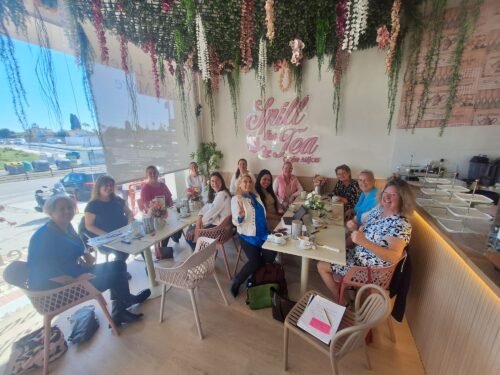
Every time I go, I see women talking to each other more openly and honestly.
I see women comparing notes.
Questioning things.
Researching.
Advocating for themselves.
Talking more openly about things like vulvas (although not very often I admit!!)
Walking into doctors’ offices better informed.
Finding second opinions.
Finding Doctors who listen and actually do something to support.
We are increasingly saying:
“No, this isn’t normal for me.”
And perhaps most importantly:
I see women beginning to trust themselves again.
That matters.
Because for many midlife women, this season is about far more than hormones.
It’s about waking up.
Waking up to:
- patterns of self-abandonment
- years of people pleasing
- emotional numbing
- performing competence while silently struggling
- carrying too much for too long
- disconnecting from ourselves in order to cope
Midlife has a way of bringing everything to the surface.
Not to punish us.
But to show us what can no longer be ignored.
And yet, even this awakening is quickly being commodified.
Everywhere we turn there’s another:
- menopause programme
- hormone “must-have”
- anti-aging solution
- expert telling us how to optimise ourselves
- product designed to “fix” us
As if women in midlife are problems to solve.
I think many of us are exhausted by that narrative.
What if midlife isn’t a decline to survive or a problem to market to?
What if it’s an invitation?
An invitation to:
- stop abandoning ourselves
- stop minimising our needs
- stop pretending we’re fine
- stop tolerating what drains us
- stop outsourcing our authority
And instead:
- reconnect to ourselves
- trust what we feel
- ask better questions
- seek support that actually helps
- honour our bodies
- tell the truth
- create lives that feel more honest
For example in January 2025 I started to have days and days of feeling so tired, lethargic, heavy, aching joints and no zest for doing anything at all. I went to the doctors and got no answers, I didn´t even consider menopause or asking for support with it as I had already been to several gynacologists (about different things) and was told “We can´t do anything until you haven´t had a period for a year.”
I had just learnt to internalise it all and therefore assumed this time it was some weird virus (looking back – strangely menopause did not even cross my mind, after all menopause was not going to affect me and I was just going to get on with it!)
A few months on I went to a Menopause Sisterhood meeting and listening to others´ stories and knowledgeable speakers it slowly started to dawn on me that this could be my version of the menopause. No hot sweats, sleepless nights or some of the other myriad of symptoms you hear of.
This was my version of menopause.
I felt a pang of resistance for HRT remembering my mum´s experiences and the scare stories as I grew up. But with my own research, finding a trusted doctor (and friend) I was reassured and found my right way to respond to my version of menopause. Thankfully 90% of the symptoms have disappeared ever since (thank goodness as I seriously would have been in trouble mentally and physically if they hadn´t).
I am starting to hear women´s own versions of this story more and more.
But we still have work to do.
Because many women are still suffering silently.
Still being dismissed.
Still feeling ashamed.
Still believing they have to just “put up with it.”
Still feeling isolated abroad without the support systems they once had (and not just here in Spain, I have heard the same in Australia, across Europe, the US and UK).

So here are a few things I believe matter deeply in this season (let me know what you think too and what I have missed out):
1. Trust our experience
We know when something feels off.
Even if someone else dismisses it.
Even if tests come back “normal.”
Even if people tell you it’s stress, age, or overreaction.
Our body are communicating.
We need to listen and act.
2. Keep talking to other women
Honestly, this may be one of the most healing things of all.
Reach out to friends, the local menopause/midlife groups for walks, coffees, cold water dips, whatever, even if it feels uncertain and uncomfortable.
The conversations many of us were missing for years are finally happening.
Not polished conversations.
Real ones.
About rage.
Brain fog.
Identity shifts.
Exhaustion.
Loneliness.
Desire.
Grief.
Relationships.
Starting over.
Feeling lost.
Wanting more.
This connection matters.
3. Advocate for ourselves
Especially in medical spaces.
Ask questions.
Seek second opinions.
Push for support.
Research.
Be curious.
Persist.
Ask around for professionals who have made a real difference.
We are allowed to take yourself seriously.
4. Be discerning about what’s being sold to us
Not every symptom needs a product.
Not every discomfort means we are failing.
Not every midlife struggle is something to optimise away.
Sometimes what we need is HRT/supplements/a medical/natural intervention but also:
- rest
- truth
- boundaries
- support
- nervous system safety
- emotional honesty
- community
- space to reconnect with ourselves
5. Stop treating midlife as an ending
This one feels important and is showing up on my website stats each day.
By far my most read articles are about konenki – the Japanese term for midlife/menopause – a time of renewal and rebirth – a new chapter.
Granted it might not always feel this way (especially until we get any medical ´stuff´ sorted), but I actually think many women become more themselves in midlife than ever before.
Less willing to perform.
Less willing to tolerate. (For example today we talked about women asking for sleep divorces to get better sleep and improve their marriages).
Less willing to shrink.
More honest.
More awake.
More discerning.
That isn’t decline.
That’s emergence.
And maybe that’s why the tide is turning.
Because women are beginning to realise:
we were never meant to disappear at this stage of life.
This is us starting to band together and wake up.
What do you think? What has been your experience so far at this stage of life ?
Also, whereabouts in the world are you and how easy is it to find the right (peri) menopause support for you? As always, I would love to hear your thoughts, comments, questions below.
Thanks so much for being here.
Emma

When your life looks fine… but doesn’t feel right

Positive Intelligence – My experiences

Our Midlife Experiment
About The Author

Emma Thorne Lees
British, but living in Spain mum of 2 teens, a dog, lover of the outdoors, food, travel, exploring, connecting, learning. Sober, recovering overthinker, people pleaser, hyperachiever. Trying to remember to be kind and compassionate with myself as much as I am with others every day. Transformational life coach for midlife women empowering women to break free from overthinking, overwhelm, uncertainty to create clarity, connection and calm.